Smartphone addiction
Does your hand reach for the phone before you have had time to think? The test shows how much this habit affects your sleep, work and in-person communication.
- 3–4 min
- 33 statements
- Anonymous
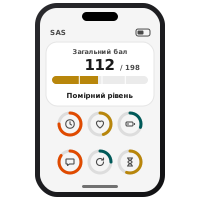
- Visual chart
Six sides of the phone habit
The test does not just count hours of screen time. It looks at what exactly has changed in your life.
Daily-life disturbance
The phone gets in the way of work, study or plans, or eats into sleep.
Positive anticipation
The screen becomes the main way to calm down, lift your mood or feel safe.
Withdrawal
Without the phone, anxiety, irritability or emptiness appear.
Cyberspace-oriented relationships
Chatting in messengers and social networks feels closer than meeting in person.
Overuse
Loss of control over time, automatic unlocking, constantly checking notifications.
Tolerance
You want to spend ever longer with the phone, and attempts to limit your time do not work.
What you get as a result
- Total score: from 33 to 198 and the level it belongs to.
- Profile across 6 subscales: you can see where the habit is stronger and where you stay in control.
- Visual chart: a clear picture instead of dry numbers.
- What to change this week: a few concrete steps for each subscale.
About the test
The questionnaire has 33 statements grouped into 6 key factors (subscales). Estimated time: 3–4 min.
Rate how much you agree with each statement on a scale from 1 to 6. Answer honestly, based on your experience over the past 12 months.
Frequently asked questions about the SAS test
More evidence and research: The Anxious Generation
Phone addiction: signs, causes and what to do
Phone addiction is a habit that has slipped out of control. A person looks at the screen longer than planned, gets nervous without the smartphone, and loses out on sleep, study or communication. There is no official diagnosis of “smartphone addiction”, so the state is assessed with questionnaires such as the SAS.
Signs of smartphone addiction
- The phone is in your hands right after waking up and just before sleep.
- The screen gets unlocked on its own, for no reason.
- Anxiety or irritability appear without the phone.
- Promises to cut down screen time are not kept.
- Sleep, tasks or in-person meetings suffer because of the screen.
Smartphone addiction in teenagers
Teenagers spend a lot of time on their phones because their friends, games and videos are there. That is why the habit forms quickly at this age and visibly affects sleep, grades and mood. The SAS was created mainly for adults, and teenagers have a separate short 10-item version, the SAS-SV. So treat the result here as a reason to talk, not as an assessment of a child.
What parents can do
- Start the conversation without blame: ask what exactly they enjoy about the phone.
- Agree on rules for the whole family: no phones at the table, and charge them outside the bedroom overnight.
- Watch for signals: poor sleep, falling grades, irritability, avoiding in-person contact.
- If it continues and gets in the way of life, see a psychologist.
Additional information about the smartphone addiction test (SAS)
Min Kwon, Joon-Yeop Lee, Wang-Youn Won, Jae-Woo Park, Jung-Ah Min, Changtae Hahn, Xinyu Gu, Ji-Hye Choi, Dai-Jin Kim (PLOS ONE, 2013)
Smartphone Addiction Scale (SAS), 33 statements on a six-point scale, 6 subscales. Original article: PLOS ONE 8(2), e56936, DOI 10.1371/journal.pone.0056936. Internal consistency Cronbach’s α = 0.967.
The SAS is a screening, not a diagnosis. The result depends on how honest the answers are and describes the past 12 months. The scale was developed on a Korean sample, and the levels in the results are approximate.