Loneliness Test
Ever feel surrounded by people yet have no one you can truly talk to? This test shows what feels missing right now: one close confidant nearby or a wider circle of connection.
- 5–7 min
- 31 statements
- Anonymous
- Instant result
Three dimensions of loneliness
Loneliness takes different shapes. This test separates it into three parts so you can inspect each in your results.
Overall feeling
How often you feel disconnected from people, even when others are physically nearby.
Emotional loneliness
Missing someone close you can trust without masks or explanations.
Social loneliness
Missing a wider circle: friends, colleagues, or a community where you belong.
What you will receive
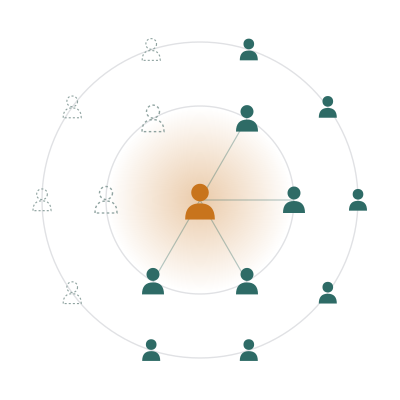
- Your closeness circles. You sit at the center of two rings showing how filled your close and wider circles feel right now.
- Overall UCLA score. A score from 20 to 80 on the UCLA Loneliness Scale with a clear explanation.
- What is missing most. Deep intimacy or broader social belonging — the answer shapes what helps best.
- Targeted next steps. Concrete, low-pressure actions tailored to your score profile.
How scores are interpreted
Thresholds match how the test categorizes your scores. Higher points indicate stronger perceived loneliness.
UCLA Loneliness Scale, 20–80 points
- 20–34
- Low level. No acute shortage of meaningful connection.
- 35–49
- Moderate level. Some closeness or wider company feels missing.
- 50–64
- Moderately high. Feelings of disconnection or isolation appear often.
- 65–80
- High level. Pronounced loneliness that has likely persisted for a while.
De Jong Gierveld Scale, 0–11 points
- 0–2
- Not lonely. Both close ties and a wider circle feel adequate.
- 3–8
- Moderate loneliness. Missing closeness, a wider group, or a mix of both.
- 9–11
- Severe loneliness. Noticeable gap in both close relationships and wider company.
How the test works
The test has two parts, 31 items in total. Part 1 uses the 20-item UCLA Loneliness Scale rated from “Never” to “Often”. Part 2 uses 11 statements from the De Jong Gierveld Scale answered “Yes”, “More or less”, or “No” by swiping or clicking.
Think about how you have generally felt lately rather than one isolated hard day. There are no right or wrong answers.
- Free, instant result
- Validated method: UCLA-3 (Russell, 1996), De Jong Gierveld
Frequently asked questions
Additional information about UCLA and De Jong Gierveld loneliness scales
References
- Russell, D. W. (1996). UCLA Loneliness Scale (Version 3): Reliability, validity, and factor structure. Journal of Personality Assessment, 66(1), 20–40. doi.org
- De Jong Gierveld, J., & Kamphuis, F. (1985). The development of a Rasch-type loneliness scale. Applied Psychological Measurement, 9(3), 289–299. doi.org
- De Jong Gierveld, J., & Van Tilburg, T. (1999). Manual of the Loneliness Scale. Vrije Universiteit Amsterdam. dotaznik.oushi.upol.cz
- De Jong Gierveld, J., & Van Tilburg, T. (2006). A 6-item scale for overall, emotional, and social loneliness. Research on Aging, 28(5), 582–598. doi.org
- Masi, C. M., Chen, H.-Y., Hawkley, L. C., & Cacioppo, J. T. (2011). A meta-analysis of interventions to reduce loneliness. Personality and Social Psychology Review, 15(3), 219–266. doi.org
- Free, instant result
- Validated method: UCLA-3 (Russell, 1996), De Jong Gierveld