Anger and Aggression Test
Buss-Durkee Hostility Inventory (BDHI)
Why does anger sometimes pull out words you never meant to say? This test shows where it usually goes: outward, sideways, into resentment, or against yourself.
- 75 statements
- Free
- Anonymous
- Instant result
Four directions of anger
The result shows not just "a lot or a little" anger, but where it usually goes.
Outward
Physical and verbal aggression: sharp words, a raised voice, sometimes actions. Anger comes out directly.
Sideways
Indirect aggression and negativism: sarcasm, silence, resistance. Anger takes a detour.
Held in
Resentment and suspicion: the anger does not come out but builds up as distrust and unresolved grudges.
Against yourself
Guilt: anger turns back on you as self-reproach and self-blame.
What you will get
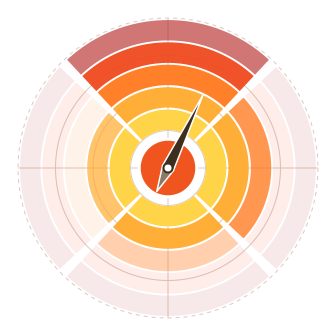
- An anger compass. A picture showing where your anger mostly goes, with a short description of your profile.
- Two indices with a norm. Aggression and hostility on a scale with the normal range marked, so you can see where you stand.
- Four cards with scales. A description of each scale with your scores: what stands behind it in everyday situations.
Which scales make up the test
The inventory measures eight forms of anger and hostility:
- Physical aggression. Anger quickly moves into the body: you want to push, hit or use force. Many people know this in moments of intense anger.
- Verbal aggression. Anger comes out in words: a raised voice, shouting, insults, threats, cutting remarks.
- Indirect aggression. Anger takes detours: gossip, irony, little digs. Sometimes it spills onto objects, for example slamming a door.
- Irritability. Small things quickly throw you off balance. Hence the sharp reply, the rough tone or the flare-up over a trifle.
- Negativism. You feel like acting against rules and demands, especially when they come from a position of authority. It can be quiet sabotage or open protest.
- Resentment. Anger stays inside as resentment. Old grievances do not let go, and sometimes envy or dislike appears toward those who seem to be luckier.
- Suspicion. It is hard for you to trust: it seems that others may be planning something against you or want to provoke you.
- Guilt. Anger turns back on you: pangs of conscience, a feeling that you are "bad" or to blame for everything.
About the method
The Buss-Durkee Hostility Inventory (BDHI) was created in 1957 to assess anger and aggressive reactions. It does not simply count whether you have a lot of anger or a little. It shows what it is made of: physical and verbal aggression, irritability, negativism, resentment, suspicion and guilt. The result helps you notice your own reactions and choose what to do with them.
The test has 75 statements. Read each one and decide whether it is true for you. Answer quickly: the first reaction is usually the most accurate. Swipe right for "YES" or left for "NO".
Frequently asked questions
Additional information about Anger and Aggression Test
Arnold Buss and Ann Durkee, 1957.
Buss-Durkee Hostility Inventory: a classic questionnaire for assessing anger and hostility. It has 75 statements and eight scales, from which two indices are calculated: aggression and hostility. Original source: Buss, A. H., & Durkee, A. (1957). An inventory for assessing different kinds of hostility. Journal of Consulting Psychology, 21(4), 343–349. The statements used here are our own adaptation and translation, and this language version has not been separately validated.
The test is for self-assessment and is not a diagnosis. The result depends on how honestly you answer. The norms are approximate.